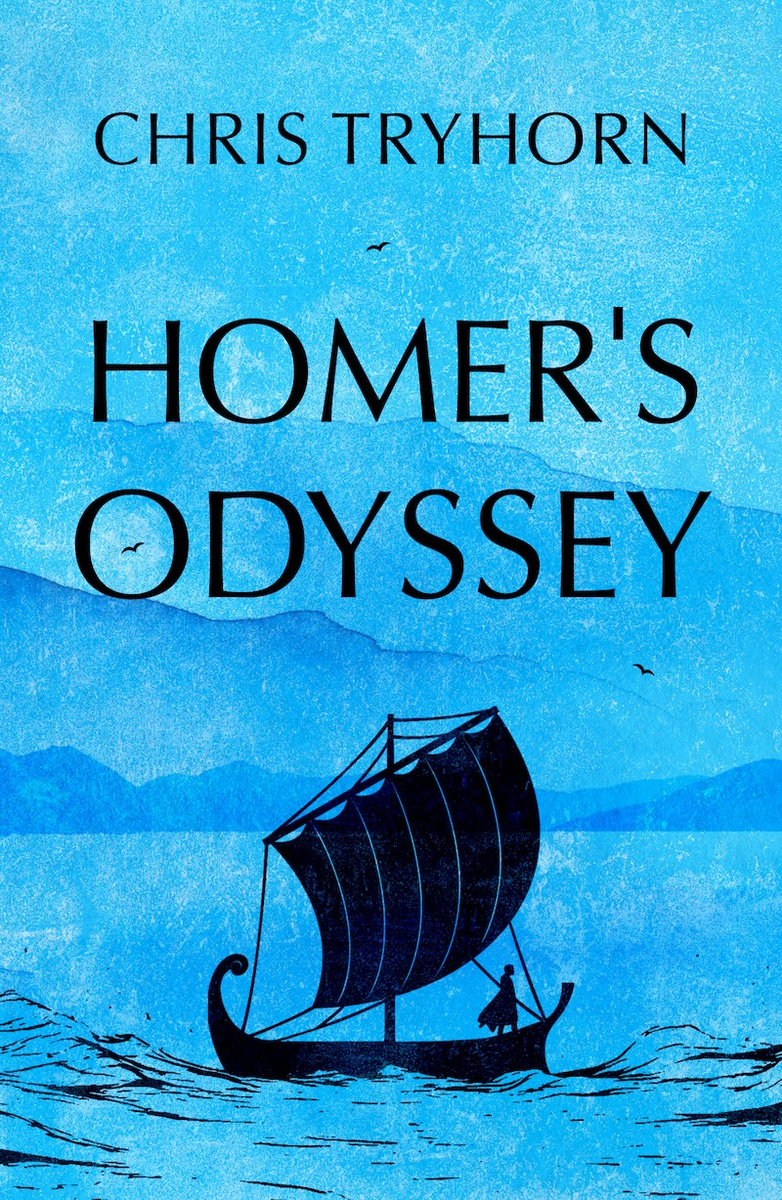
IChris Tryhorn
Homer’s Odyssey
A clear, accessible version of Homer’s ancient epic
The story of the Greek hero Odysseus and his long journey home from Troy has been told and re-told for centuries: how he outwitted the Cyclops, survived the enchantments of Circe and the Sirens and used all his cunning and bravery to confront the suitors laying claim to his wife, Penelope. Chris Tryhorn has returned to Homer’s ancient Greek poem to provide modern readers with a clear, accessible version that aims to tell the original story in a pacier, more direct way than a full translation can.
Written with a faithful attention to detail but with the general reader in mind, this book brings to life all the wonderful scenes and characters from Homer’s poem, from Odysseus’ encounter with the young princess Nausicaa and his meeting with the ghosts of his old comrades Achilles and Agamemnon to his escape from the monster Scylla and the whirlpool Charybdis. We follow Odysseus as he returns to his home island of Ithaca to reclaim his palace from the odious suitors and is reunited with his family.
An unforgettable tale that has had untold influence on western literature, the Odyssey is also a profound and moving portrait of survival, exile and homecoming. This new version, which contains extensive notes analysing Homer’s themes and artistry, aims to refresh the appeal of this immortal masterpiece for today’s readers.
- Format
- eBook
- Published
- 17 July 2026
- Price
- £4.99
- eISBN
- 9781806348879
II
Begin the journey





IIIInside the epic
How I came to write Homer’s Odyssey
The first time I tried to read the Iliad, one of the two Ancient Greek epic poems attributed to Homer, it was in a modern verse translation. I struggled with it, despite being a keen student of ancient literature at school. Later, I was lucky enough to read the whole of the Iliad in the original Greek as part of my university degree, and I couldn’t believe how wonderful it was. The difference between how it came across in translation — heavy-going, monotonous, and at times turgid — and the thrilling experience of reading it in the original stayed with me.
Many years later, as my children were developing an interest in Greek mythology, I thought I would try to write a version of the Iliad that tried to capture the excitement and profundity of the original text. It couldn’t be a translation — the world already had plenty of those and I wasn’t the right person to write another. It needed to be shorter and pacier than a full-length translation and would therefore have to leave out details or even whole passages that didn’t seem essential. At the same time, I didn’t want my version to be a re-telling from some new perspective or an anachronistic re-write that reflected the concerns of our own times more than Homer’s. Perhaps it was a hubristic task, but as a journalist I have always believed in the importance of clear, accessible writing. I was aiming for something readable and authentic in plain English prose rather than going for literary effect.
I wrote the book but couldn’t find an agent. I still hope to publish it. I then turned to the Odyssey, Homer’s other great epic. It’s worth noting that we don’t actually know who Homer was, and many scholars think the Iliad and the Odyssey were created by different authors; it’s possible that both evolved over long stretches of time through the performances of many different oral poets. Nevertheless, the two poems are closely related to each other: the Odyssey is a kind of sequel to the Iliad — or, you might say, a spin-off featuring one of its best characters, Odysseus.
I hadn’t thought the Odyssey needed the same treatment as the Iliad to make it more readable — it is a shorter poem and it tells a more obviously involving story — but as I tackled the task of making my own version, I realised that there was much I could do to make it more accessible for a general reader. As with the Iliad, I left out unnecessary details and dispensed with the stylings and repetitions that are a feature of the Homeric poems, and tried to streamline the story so that the narrative flowed easily.
As I wrote the book that became Homer’s Odyssey, it became clear that there would be a major burst of interest in the Odyssey with the release of Christopher Nolan’s film adaptation in July 2026. This seemed like the perfect moment to put my own version out into the world and so I published it as an ebook with Troubador. I hope readers who have yet to encounter the magic of the Odyssey will find my book a helpful introduction to a work that has had such a huge influence on western literature in the centuries since it was composed.